

The question comes up before almost every first session and in every online forum where someone is working up the nerve to begin. Am I too old? The person asking is usually somewhere between 30 and 50, has been curious about Muay Thai for longer than they want to admit, and has found a hundred reasons to keep postponing. Age is the one that feels most legitimate.
It feels legitimate because it sounds like a fact rather than an excuse. Unlike saying you are too busy or not fit enough, the age concern carries an air of biological authority. The body slows down. Recovery takes longer. Young people learn motor skills more rapidly. All of this is true, as far as it goes. But the conclusion most people draw from these facts, that they are therefore too old to start, does not follow from the evidence.
Here is an honest account of what starting Muay Thai as an adult actually looks like, what you will find harder than younger students, and what you may find, somewhat to your own surprise, you are better at.
What Actually Changes with Age
Recovery takes longer in your 30s and 40s than it did in your teens. This is worth accepting as information rather than fighting as an obstacle. Two hard sessions back to back that a 22-year-old moves through without much thought will leave a 40-year-old noticeably stiffer the following morning. This is not a reason not to train. It is a reason to structure your training intelligently.
The initial cardiovascular adaptation takes a little longer too. The first month of Muay Thai is a shock to the system at any age, but the shock is more pronounced in someone returning to athletic activity after years away from it. The sessions will feel harder early on. This also passes, and it passes faster than most people expect if the training is consistent.
What does not change is your capacity to learn technique. Adults frequently learn technical skills with more precision and more retention than young children do, partly because they understand the reasoning behind what they are being taught and partly because they have the patience to focus on process rather than demanding immediate results. A 45-year-old who concentrates on technique will develop better mechanics than a 20-year-old who relies on youth and energy to compensate for poor form. This is not a consolation. It is a genuine advantage.
What Older Beginners Often Have
The advantages of starting later are rarely talked about, possibly because they are less dramatic than the obvious physical concerns. They are real nonetheless.
Adults bring accumulated life experience that informs how they approach difficulty. They tend to have more self-awareness and a longer reference for what it means to learn something genuinely hard over time. They are less likely to quit after the first tough week because they have experienced setbacks in other contexts and know the pattern: it gets easier, and then it becomes something you love.
Older beginners are often more consistent. They have made a considered decision to train. They are not there because their friends dragged them along or because they had a free evening. Consistency over time is worth more in Muay Thai than almost any other single factor, and adults who commit tend to commit properly.
The mental qualities of the sport also tend to resonate differently at 40 than at 18. The focus required during a pad round, the meditative quality of drilling a technique several hundred times, the satisfaction of incremental improvement visible over months of effort. These things land with a different weight when you have enough life behind you to understand that progress worth having is rarely fast.
Old Man Strength Is a Real Thing
There is a phrase you hear around gyms and building sites and anywhere else where older men do physical work. Old man strength. The phenomenon is real and the science behind it is worth understanding, because it applies directly to what you are about to experience in Muay Thai.
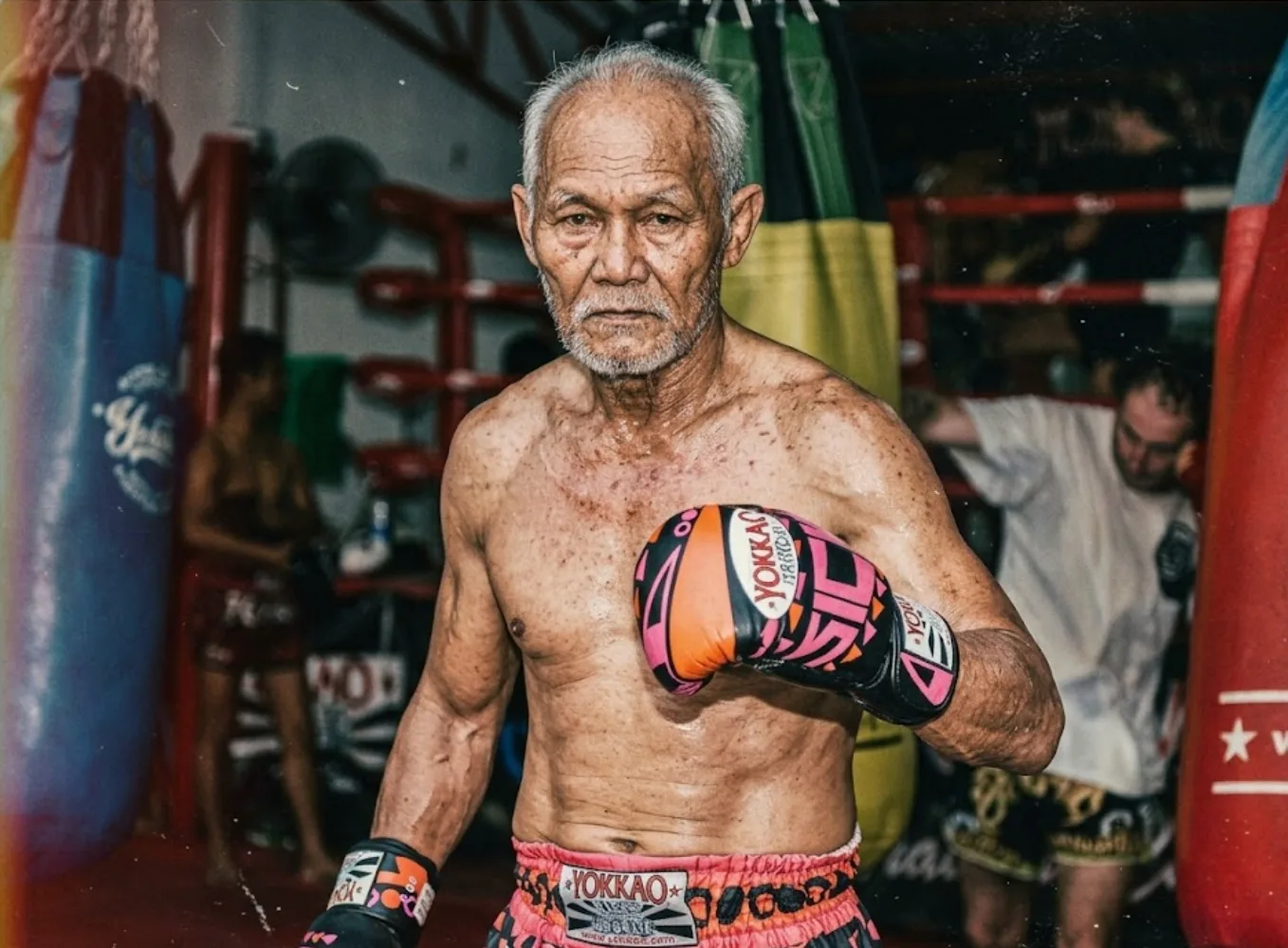
What the research shows is that the nervous system becomes more efficient at recruiting muscle fibres as we age. Neuromuscular control improves up to around age 55. This means an older practitioner who has been training consistently does not just have technique on their side. They have a nervous system that has learned to activate muscle more effectively. The movement looks effortless because the coordination behind it is extraordinary. When you watch a 50-year-old trainer throw a combination and it looks easier than anything the 25-year-olds in the room are producing, that is why.
Muscle memory compounds this. Decades of repeated physical movement create ingrained mechanics that younger athletes simply have not had the time to develop. An older practitioner who has been throwing the same elbow for fifteen years is working off a motor pattern so deeply encoded that it survives fatigue, stress, and distraction. That is not something you can buy with youth.
The honest numbers on muscle loss are worth knowing. Adults lose roughly 3 to 5 percent of muscle mass per decade after 30, and without intervention that decline accelerates meaningfully past 50. But here is the part that does not get mentioned enough: studies consistently show that older adults who engage in strength training can slow or largely reverse those losses. Research from the Netherlands demonstrated that men in their 80s and 90s made significant strength gains within twelve weeks of resistance training. The body responds to challenge at every age. It is not doing you a favour by giving up quietly. Push it and it pushes back.
Strong Legs, Long Life: The Science You Need to Hear
There is a body of research that does not get nearly enough attention outside sports science circles, and it is directly relevant to anyone considering starting Muay Thai in their 40s, 50s, or beyond. Leg strength in middle age and later life is one of the strongest predictors of longevity we have. This is not a motivational metaphor. It is a measurable, documented, repeatable finding.
The mechanism is straightforward once you see it laid out. Weak legs lead to reduced mobility. Reduced mobility leads to falls. Falls in older adults lead to hospitalisation. Hospitalisation leads to extended inactivity. Extended inactivity accelerates deterioration across every body system. One fall, in a person who was already moving less than they should have been, can be the beginning of a decline that has no good ending. This is not a dramatic extrapolation. This is the pattern, documented across populations.
The opposite direction works just as powerfully. Strong legs maintain mobility. Maintained mobility keeps you active. Activity builds more strength. Strength keeps you capable and independent. Independence means you are still the person choosing what you do with your days, rather than having those choices made for you. The leg muscles are the largest in the body, and how you treat them in your 40s and 50s has consequences that reach well into your 70s and 80s.
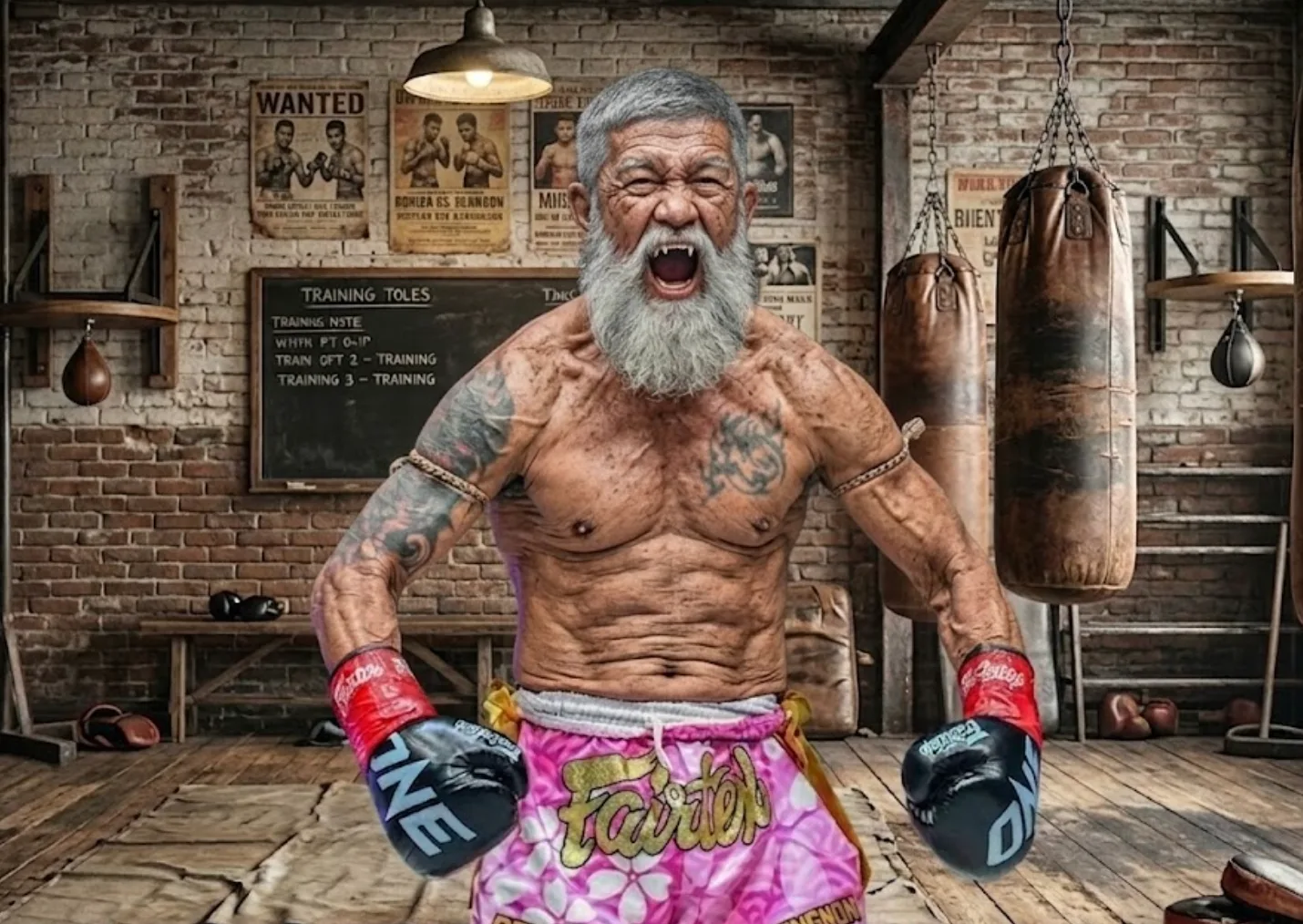
Muay Thai is one of the most effective tools available for building and maintaining leg strength in a way that is also technically engaging, socially rewarding, and genuinely enjoyable. The kicking volume in training builds the quadriceps, hamstrings, glutes, and calves in a functional way that a leg press machine in a commercial gym simply cannot replicate. You are not just getting stronger. You are getting stronger in patterns of movement that have real-world application for balance, coordination, and everyday physical capability.
What You Need to Adjust
Two things genuinely require adaptation for adult starters. The first is recovery. Build rest days into your training week and take them seriously. Three sessions per week with proper rest between them will produce better long-term results than five sessions with accumulated fatigue undermining each one. The body at 40 is not less capable. It runs a different programme and requires different inputs to perform well.
The second is sparring. Get into sparring gradually, and make sure the gym you choose has a culture of controlled, respectful sparring for all levels. Hard sparring at full intensity early in your training, regardless of age, does not produce the best development outcomes. At 40, it is also more likely to accumulate the kind of wear that limits your enjoyment of training further down the line. Ask gyms directly about their sparring culture before you join. A good gym will have a considered answer. If you have not yet found your gym, our practical guide to choosing your first Muay Thai gym covers what to look for at every stage.
The People You Will Find When You Get There
You do not need to look far. Most Muay Thai gyms in any city have members who started in their 30s and 40s and who now train consistently, move well, and in some cases compete at amateur level. Some of the most technically refined practitioners in any gym are not the youngest people in the room.
In Thailand, where the sport is rooted most deeply, practitioners who have loved it for decades continue training well into their 50s and beyond, adjusting the intensity as the years accumulate but maintaining the practice because it has become part of who they are. That is a long-term relationship with something you love. It is not available at 20, because you have not had the years yet. It becomes available the moment you start, at whatever age that is.
The Only Question Worth Asking
The age question is really a proxy for a different question, which is what you actually want from this. If the answer involves fighting professionally at a high level, the window for that is narrow and likely already closed for a 45-year-old beginner. Be honest about it and adjust your expectations accordingly.
If the answer involves learning a genuinely extraordinary martial art, becoming significantly fitter, finding a community of people who share a practice you love, and doing something with your body that is challenging and rewarding for as long as you choose to continue: then the age at which you start does not matter in any meaningful sense.
The only people who are too old to start Muay Thai are the ones who decided not to. Everyone else is just a beginner at a different point on the same journey.
Start now. The gym has been open the whole time you were waiting.
Frequently Asked Questions
What is the best age to start Muay Thai?
There is no single best age. Children who start early develop exceptional technique over many years. Adults who start later bring patience, consistency, and life experience that often makes them more disciplined learners than younger students. The best age to start is the age you are when you decide to begin.
Can I start Muay Thai at 40?
Yes. Many people begin training in their 40s and train consistently for years. The adjustments required are primarily around recovery: taking rest days seriously, building training volume gradually, and finding a gym with a sparring culture that matches your goals rather than one that pushes all students toward hard sparring regardless of age or experience. The technique and fitness gains available to a 40-year-old beginner are real and significant.
Is Muay Thai hard on the body as you get older?
Any demanding physical practice places load on the body, and recovery does take longer as you age. The key is structuring your training intelligently: three to four sessions per week with proper rest days, building intensity gradually, and prioritising technical sparring over hard sparring in the early stages. Many practitioners train well into their 50s by adjusting their approach rather than abandoning the sport.
Will younger students progress faster than me?
In terms of initial cardiovascular adaptation and some aspects of motor learning, younger students may adapt slightly faster in the early weeks. Adults often compensate through more deliberate technical focus, greater consistency, and patience with the learning process. Over six to twelve months of training, adult beginners who train consistently typically develop solid foundations that reflect their commitment rather than their starting age.
Can older Muay Thai practitioners compete?
Yes. Many promotions have masters and veterans categories for amateur competitors over 35 and 40. Competing is entirely optional, but it is available if that is a goal. Most adult practitioners who start in their 30s and 40s train for the practice itself rather than competition, which is an equally valid and rewarding path.