

Shin guards are one of those pieces of Muay Thai equipment that beginners tend to underestimate and experienced practitioners have strong opinions about. Walk into any established gym and ask around about shin guard recommendations and you will quickly discover this is not a neutral topic. People care about their shin protection in a way that reflects how important it actually is.
Your shins take damage in Muay Thai in both directions. When you kick, the impact is transmitted through the shin bone and the muscle around it. When your opponent kicks and you check the strike, the same bones absorb the force. Without adequate protection in training, that repeated impact accumulates into the kind of chronic shin bruising and bone density stress that takes fighters out of training for weeks at a time.
Buying the right pair of shin guards at the start saves you a significant amount of discomfort later. This guide covers what to look for, what to avoid, and the practical questions that determine which type is right for your training.
What Shin Guards Actually Need to Do
The primary function of a shin guard is to protect the shin bone and the surrounding tissue from repeated impact during sparring and controlled drilling. They are not designed for full-contact competition, where fighting without protection is standard. They are designed for training, where the goal is to work hard without accumulating unnecessary damage.
A good shin guard absorbs and distributes impact rather than simply covering the shin. The padding needs to be dense enough to genuinely reduce the force your partner feels when you kick, because training with someone who has inadequate shin protection means your partner's shins are absorbing more than they should. Good shin guards are respectful to your partners as much as they are protective for you.
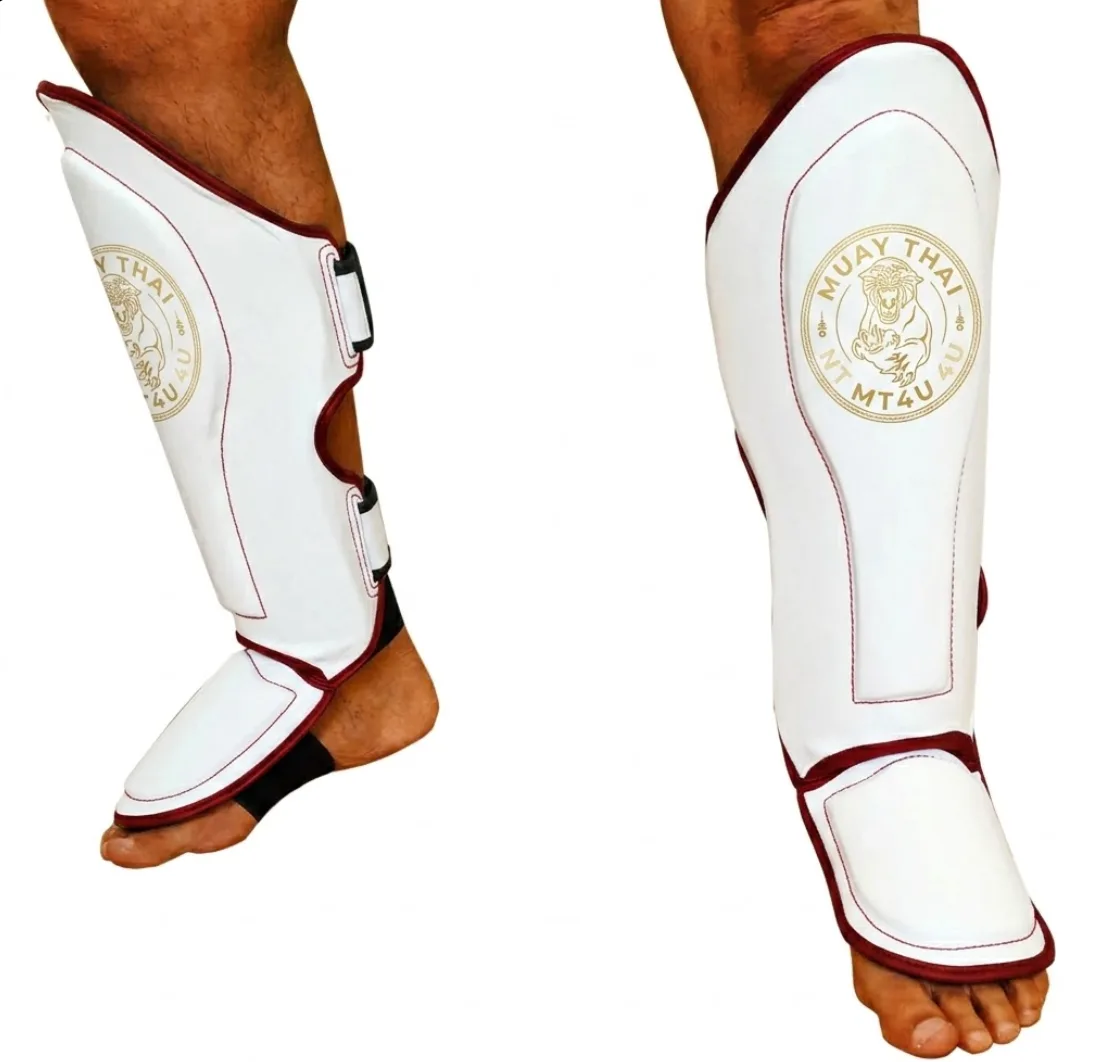
The instep coverage matters. The top of the foot is exposed on every kick and many sweeps. Shin guards that cover only the shin and leave the instep unprotected are a compromise that becomes noticeable quickly. Full shin-to-instep coverage is the standard for any guard used in regular sparring.
Types of Shin Guard
Slip-On Shin Guards
Slip-on guards are a single padded sleeve that goes over the foot and up the shin, with no straps. They are light, easy to put on and remove, and have no risk of Velcro or straps working loose during a session. The limitation is that they move more than strap-on guards under repeated impact and can ride up during kicking exchanges, leaving the lower shin or instep exposed at the wrong moment.
Slip-ons are popular in Thai gyms for this reason: they are quick, simple, and functional for controlled technical work. For beginners in Western gyms who are doing harder sparring, they are usually less reliable than a well-made strap-on guard.
Strap-On Shin Guards
Strap-on guards use one or two Velcro straps around the ankle and sometimes the calf to keep the guard in position. They stay put more reliably than slip-ons during hard kicking exchanges, the padding is typically thicker, and the coverage tends to be more comprehensive. The trade-off is the strap hardware. Cheap Velcro on a strap-on guard fails faster than almost any other component on Muay Thai equipment. The strap system is the first thing to check on any guard you are considering.
Competition-Style Guards
These are heavier, more extensively padded guards sometimes used for hard sparring or fight preparation. They are not necessary for most regular training and the additional weight affects movement enough that wearing them for every session is counterproductive. Worth knowing they exist, but not a starting point for a beginner.

What to Buy: Specific Guidance
For a beginner training at a serious gym, a strap-on guard from an established brand in a medium-density padding option is the right starting point. Fairtex, Twins, Top King, and Yokkao all produce solid guards that last well, sit correctly on the leg, and provide genuine protection rather than the padded illusion of it.
Size matters more than people expect. Shin guards sized incorrectly for your leg length will either expose the lower shin or bunch uncomfortably at the knee. Most brands offer sizing guides based on height and weight. Use them. A guard that fits correctly is a different experience from one that is slightly the wrong size, and the difference compounds over the length of a hard session.
Budget realistically. Quality shin guards from reputable brands cost between 1,000 and 4,000 baht (around $30 to $115). That is the range where you get genuine padding, reliable hardware, and materials that hold up to regular washing and sustained use. Below that range, the compromises start to matter: thinner padding, weaker Velcro, materials that compress permanently after a few months rather than recovering between sessions.
What to Avoid
Unbranded guards from generic online retailers are the most common mistake beginners make. They look similar to the real thing in product photographs, carry a low price that seems reasonable, and fall apart in ways that only become apparent after several training sessions. The padding compresses permanently, the straps fail, and the instep coverage turns out to be cosmetic rather than protective.
Avoid any guard where the strap hardware is plastic rather than reinforced nylon or metal. Plastic buckles and plastic Velcro backing fail under the lateral force of repeated kicking in a way that metal components simply do not. If the hardware looks flimsy in a product image, it will feel flimsy after a month of use.
Shared gym shin guards, where they exist, deserve a separate mention. Communal equipment in gyms is hygienically questionable at the best of times. Shin guards that multiple people have been sweating into for months are in a different category. If your gym offers them for beginners to borrow, use them for your first session while you find your feet, then invest in your own pair. Your skin will thank you.
Looking After What You Buy
Shin guards accumulate sweat and bacteria at a rate that makes regular cleaning non-optional. Wipe the interior after every session with an antibacterial spray or cloth, and allow them to air dry completely before the next use. Never put damp shin guards into a kit bag. The enclosed environment breeds exactly the kind of bacterial growth you do not want against your skin for two hours during sparring.
The exterior leather or synthetic leather benefits from occasional conditioning. The same products used on boxing gloves work on shin guards. A conditioned exterior lasts significantly longer than one that is allowed to dry out and crack. If you are spending 60 pounds on a pair of guards, spending two pounds and five minutes on maintenance makes them last three times as long. That is a straightforward calculation.
The fighters who take care of their equipment consistently are the same people who show up consistently, train consistently, and improve consistently. It is not a coincidence. The attention to detail that makes a good training partner is the same attention to detail that extends the life of every piece of gear in your bag.
Frequently Asked Questions
Do I need shin guards for Muay Thai?
Yes, if you are sparring. Shin guards are essential protective equipment for any training that involves contact with a partner's shins, legs, or body. They protect both you and your training partner from the cumulative impact of repeated kicking exchanges. For bag and pad work without a partner, they are not required, though some practitioners wear them during heavy bag sessions for conditioning purposes.
What size shin guards should I buy?
Most brands size shin guards by height and weight rather than a single measurement. As a general reference: fighters under 60kg typically fit a small, 60 to 75kg a medium, 75 to 90kg a large, and above 90kg an extra-large. The most important fit consideration is that the guard covers from just below the knee to across the instep of the foot without bunching or leaving gaps at either end.
How long do Muay Thai shin guards last?
Well-made shin guards from established brands last two to four years of regular training with proper care. The main failure points are the straps and Velcro closures, which wear faster than the padding itself. Budget guards from unbranded sources typically show significant degradation within six months of regular use. Proper cleaning and airing after each session meaningfully extends the lifespan of any guard.
Can I use MMA shin guards for Muay Thai?
MMA shin guards are shorter and less padded than Muay Thai-specific guards, designed for grappling-integrated training rather than the high volume of kicking exchanges in Muay Thai sparring. They provide less instep coverage and thinner padding across the shin. They are usable for light technical Muay Thai work but are not adequate for regular hard sparring. If your training is primarily Muay Thai, buy Muay Thai shin guards.
What brands of shin guards are most trusted in Muay Thai?
Fairtex, Twins Special, Top King, and Yokkao are the most consistently recommended brands among serious Muay Thai practitioners. All are Thai-manufactured or Thai-heritage brands with long track records in the sport. For those outside Thailand, Fairtex and Twins are the most widely available. Rival and Title are reputable Western alternatives. All offer a meaningful step up from unbranded generic options in terms of padding density, hardware quality, and durability.