
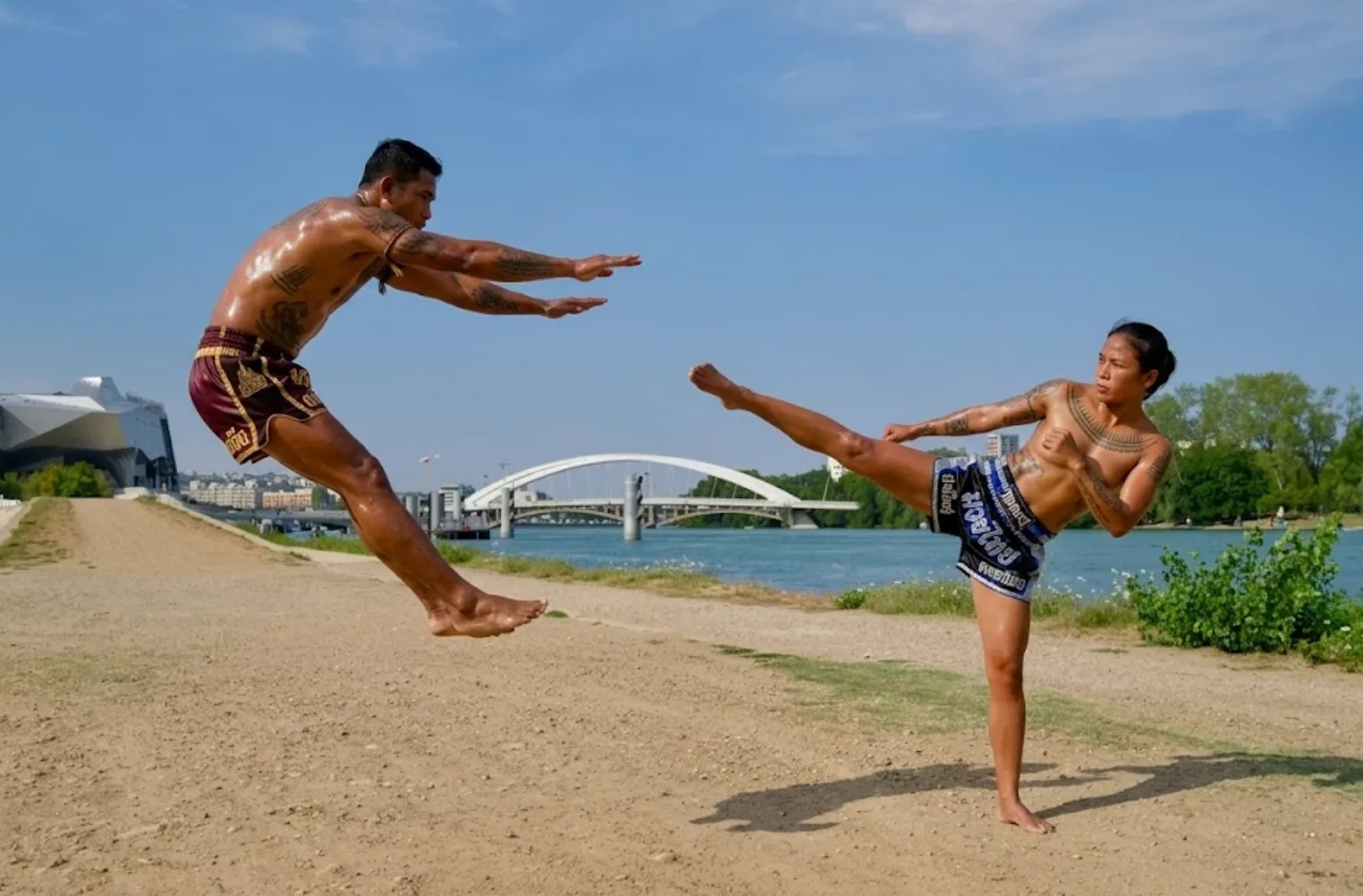
You hear it before you see it. A sharp crack of hardened shin meeting pad, a sound that carries to every corner of the gym and makes every other pair of sparring partners instinctively glance across. It is the sound of a well-thrown roundhouse kick.
Every striking sport has a roundhouse kick. What Muay Thai does differently is what it uses it for. In other disciplines, the kick scores points. In Muay Thai, it is built to do damage. Thrown with the shin rather than the foot, powered by full hip rotation and complete follow-through, it is not a tool for accumulating rounds. It is a finishing weapon. At the speed elite Thai fighters throw it, it has often already landed before the opponent has finished processing that it was coming.
If you want to understand Muay Thai, you need to understand the roundhouse kick completely. Not just how to throw it, but what makes it work, who throws it best, and what your options are when one is aimed at your thigh.
The Complete Breakdown: Every Part of the Movement
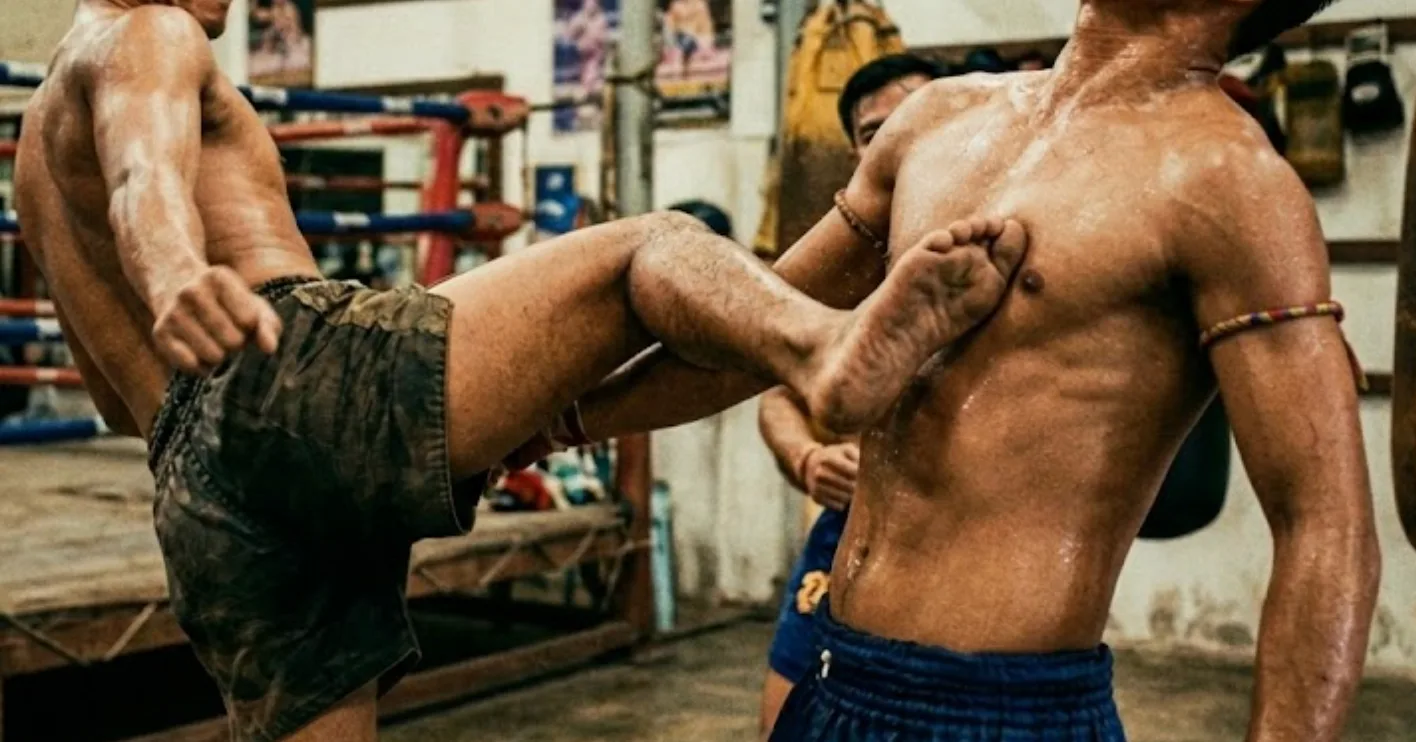
Throwing a good roundhouse kick is not a single action. It is a chain of coordinated movements, each one feeding into the next, each one contributing to the power of the final connection. Understanding each part in isolation is how you identify and fix the weak points in your own kick.
-
- The Stance. Your base foot is at roughly shoulder-width, weight evenly distributed. The rear foot will become the kicking leg. Hands stay high, chin tucked.
-
- The Step. A small step forward on the lead foot closes the distance and builds momentum. The step is subtle. Stepping too wide throws off the balance at the end of the kick.
-
- The Pivot. The base foot rotates outward as the kick launches. The heel comes up, the ball of the foot turns, the body begins to rotate. This is the most commonly skipped part and the single biggest reason kicks lose power.
-
- The Hip Drive. The hips drive through in the direction of the target. The hip leads the leg, not the other way around. A kick with no hip rotation behind it is just a leg swing. The hip is where the real force is generated.
-
- The Chamber. The knee lifts slightly before the leg extends. This disguises the technique, making it look briefly like a knee strike is incoming. It also builds torque in the hip.
-
- The Swing Path. The leg extends in a wide arc, travelling horizontally toward the target. The aim is the shin, not the foot. Contact made with the foot is weak and risks injury.
-
- The Contact Point. The lower third of the shin connects with the target. Fighters develop the shin through years of conditioning against heavy bags, pads, and controlled sparring. A conditioned shin is significantly harder than one that has not been worked on.
-
- The Follow-Through. The leg continues past the point of impact. Stopping the kick at the moment of contact loses power. The follow-through ensures full energy transfers into the target.
-
- The Recovery. The leg snaps back immediately after impact, the foot returns to the ground, and the guard resets. Leaving the leg extended is an invitation for a catch or a counter.
Every experienced trainer will tell you that most beginner roundhouse kicks break down between steps four and six. The hips fail to rotate, the arm drops on the kicking side, and the result looks like a side kick. Drill the hip rotation in isolation first. The rest builds on top of it.
The Hip Is Everything
If there is one single piece of technical advice that improves a roundhouse kick faster than anything else, it is this: the hip drives first. Not the leg. Not the swing. The hip.
Watch Yodsanklai Fairtex throw a left kick in slow motion and you can see it clearly. The leg is almost a passenger in the first half of the technique. The hip rotates, the body turns, and the leg follows that rotation into the target with all the force it has generated. The leg is the weapon. The hip is the weapon's engine.
Beginners try to kick with the leg and wonder why experienced fighters' kicks feel twice as heavy. The answer is always the hip. Fix that and everything else improves with it.
The Best Roundhouse Kickers of All Time
Yodsanklai Fairtex
Yodsanklai Fairtex is the name that comes up first in any serious conversation about the roundhouse kick. The Thai southpaw had a left kick that was genuinely frightening, a combination of exceptional hip mechanics, perfect timing, and iron shins built through years of conditioning. He won multiple world titles across different organisations and his highlight reel is essentially a museum of the perfect roundhouse kick. If you are going to study one fighter's kicking technique, study his.
Buakaw Banchamek
Buakaw's roundhouse was not the most technical in the game, but it was devastating in a different way. He kicked early and often, targeting the thigh relentlessly and compounding damage with every round. By the later rounds of a Buakaw fight, opponents were limping. His kicks were built on extraordinary conditioning and a willingness to throw with full commitment every single time.
Saenchai
Saenchai's roundhouse was a precision instrument. He did not throw for power the way Yodsanklai or Buakaw did. He threw for timing and placement, finding openings at angles other fighters simply did not use. His ability to throw the roundhouse from awkward positions and unexpected distances is part of what made him impossible to prepare for.
Tawanchai PK Saenchai
The current era's answer to Yodsanklai. Tawanchai's left kick has the same quality of technical perfection: the hip drives cleanly, the shin lands flush, and the power generated is completely disproportionate to the apparent effort of the throw. He has stopped opponents with a single roundhouse in ways that make experienced viewers rewatch the footage.
How to Block, Defend, and Parry the Roundhouse
Understanding the roundhouse from the other side of it is just as important as learning to throw it. There are four main options when one is coming toward you, and each suits a different situation.
The Shin Check
The most reliable defence against a leg kick is to raise the shin to meet the incoming technique. Lift the knee, angle the shin outward, and let the opponent's kick connect with bone rather than muscle. Done correctly, it hurts the kicker as much as the person defending. The key is timing: the check has to happen before the kick lands, not as a reaction after it connects.
The Catch
The catch is the more advanced option, more rewarding when it works and more risky when it does not. The kick is received on the forearms and caught, disrupting the opponent's balance and opening a counter. It requires good hands and sharp timing. Beginners who attempt the catch and miss it typically absorb the full force of the kick they were trying to control.
Creating Distance
A well-timed step back takes you out of range and lets the kick pass without landing. This leaves the kicker briefly off-balance and creates a counter opportunity. The difficulty is reading the kick early enough to create distance before it lands, which requires pattern recognition built through sparring rather than drilling.
The Cover
When you cannot check, catch, or step away, the cover is the fallback. Elbow down, forearm tight against the ribs, absorb the kick on the arm rather than the body. It reduces damage rather than eliminating it. Against repeated body kicks, the forearm will fatigue, which is why this defence alone is never a long-term strategy.
The roundhouse kick takes years to develop properly. The mechanics are straightforward to understand, but the conditioning, timing, and reflexes required to throw it well under pressure, and to defend against it consistently, are built through thousands of rounds of deliberate training. Start with the hip. Fix the pivot. Snap it back. The rest follows in its own time.
Frequently Asked Questions
What part of the leg do you hit with in a Muay Thai roundhouse kick?
You strike with the lower third of the shin, not the foot. The shin is harder and more durable than the foot, and a kick that connects with the instep or toes risks injury to the kicker. Developing a conditioned shin through regular bag work and pad training is what gives the technique its power.
What is the difference between a roundhouse kick and a side kick?
A roundhouse kick travels in a horizontal arc toward the target, with the hip driving through and the shin making contact. A side kick travels in a straight line directly into the target, using the heel rather than the shin. They use different mechanics, target different areas, and serve different tactical purposes.
Why does a Muay Thai roundhouse kick hurt more than other roundhouse kicks?
Muay Thai fighters condition their shins over years of training, making the striking surface harder and more dense than an untrained leg. The technique also emphasises full hip rotation as the primary source of power rather than leg speed alone. Combined with a conditioned shin and complete follow-through, the result is significantly more force delivered to the target.
How do you defend against a Muay Thai roundhouse kick?
The four main options are the shin check (raising your shin to meet the kick), the catch (receiving and holding the kick on your forearms), creating distance (stepping back to let it pass), and covering up (absorbing the kick on the elbow and forearm). The shin check is the most reliable for beginners; the catch is the highest-risk, highest-reward option.
Who has the best roundhouse kick in Muay Thai history?
Yodsanklai Fairtex is most frequently cited by trainers and fighters as the gold standard for roundhouse technique, particularly his left kick as a southpaw. Buakaw Banchamek is noted for the most feared leg kick in terms of cumulative damage. Tawanchai PK Saenchai represents the current era's best example of the technique at elite level.