
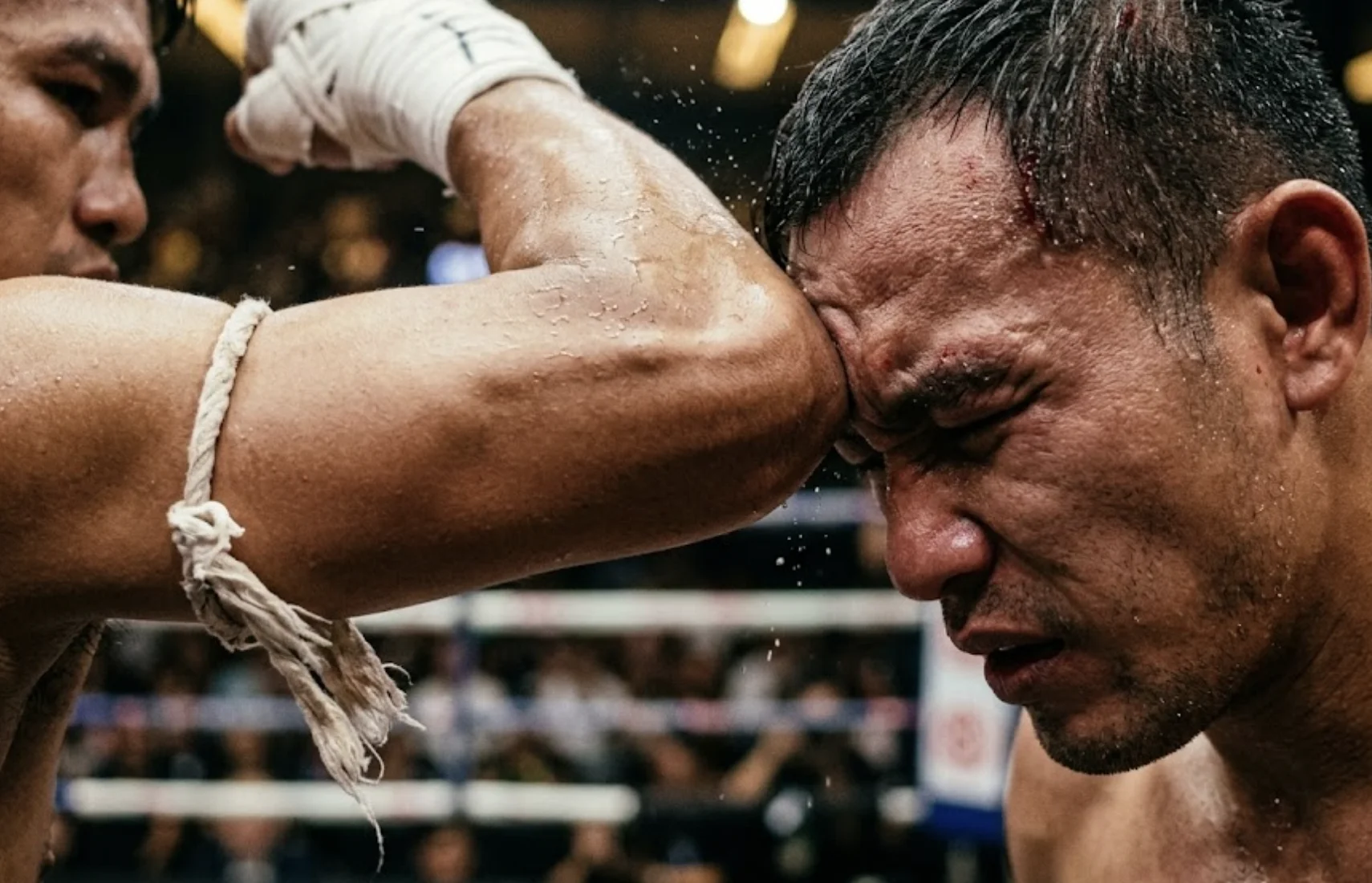
The elbow looks like the simplest weapon in Muay Thai. There is no wind-up, no elaborate setup, no technical requirement that does not apply equally to any other close-range movement. Watch a beginners' class and the elbow drill looks almost crude compared to the roundhouse kick.
It is crude in the same way that a scalpel is crude. The precision is in the application, not the mechanism.
What an elbow does when it connects cleanly, on the right surface, from the right range, is different in kind from what a punch or a kick produces. It concentrates force onto roughly the area of a coin, using a striking surface harder than anything the human body presents as a target. The result on contact is not bruising. It is a cut. And a cut changes the fight.
The Tool the Other Sports Left Out
Kickboxing bans elbows. Most MMA promotions allow them in some form. Boxing has never considered them. The fact that Muay Thai retains the elbow while every other striking sport has removed it tells you something important about what Muay Thai is actually trying to replicate.
The elbow functions at the range where every other tool breaks down. Too close for a full punch. Too close for a kick. Arms in contact. This is the position that boxing referees step in to break, that kickboxing rules penalise for inaction, that other striking arts treat as a temporary interruption. In Muay Thai, it is an offensive position. The clinch is not a pause. It is where elbows happen.
Removing the elbow from a striking art removes the primary weapon of the range that combat most naturally produces. That is a significant omission. It is also why practitioners crossing from other striking arts into Muay Thai need to develop a specific fluency with both throwing and defending elbows that their previous training never addressed.
The Three Elbows Worth Learning First
Muay Thai categorises many elbow variations, but three form the foundation of any practical elbow game.
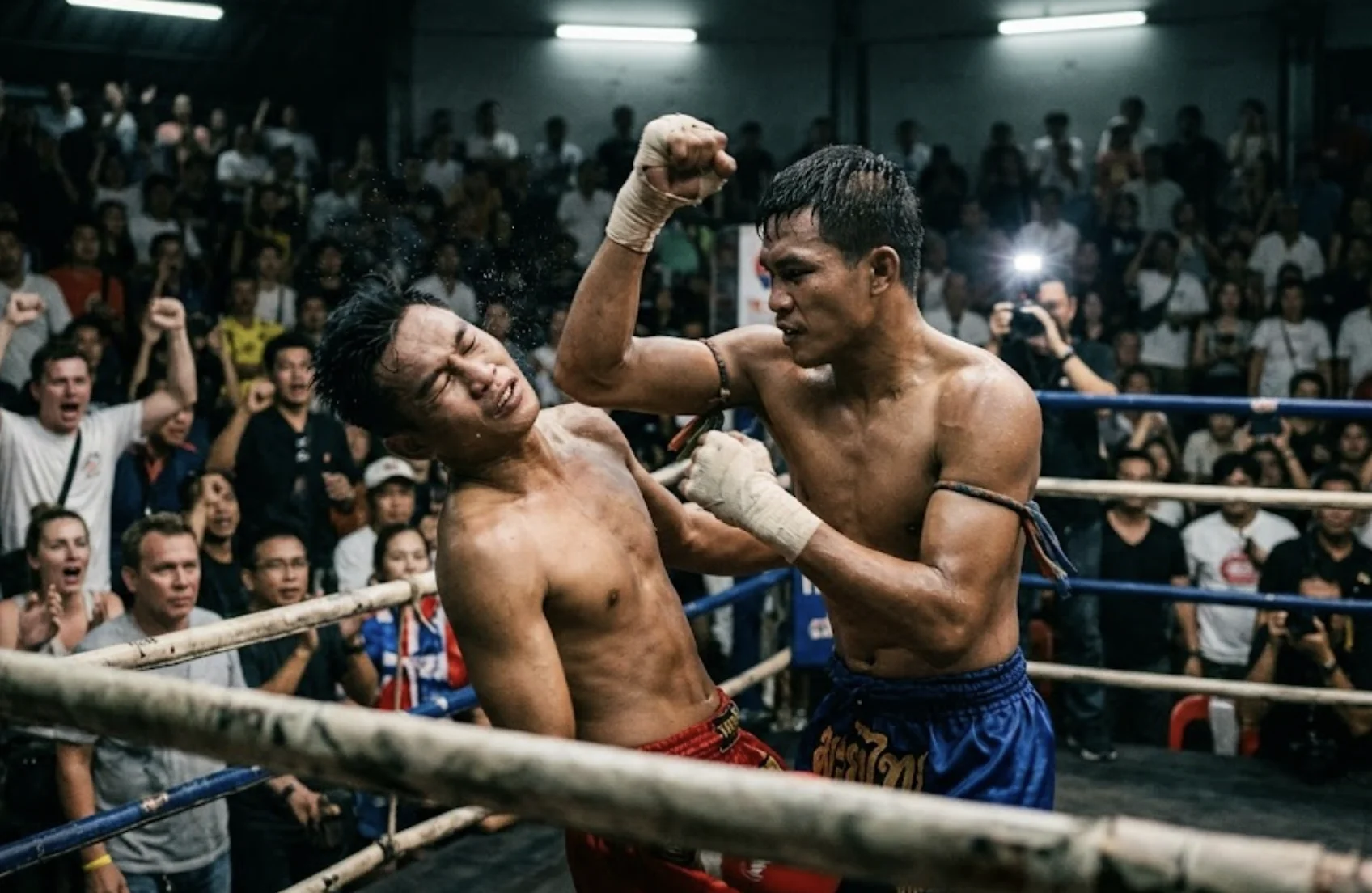
The horizontal elbow (sok tat) travels across the body on a flat plane, targeting the temple or jaw. The power source is the rotation of the torso and hips, the same rotational chain that drives a hook punch, with the arm following the body rather than driving it. This is the most common elbow in competition and the one most likely to produce a cut, because the temple and the area around the eye are particularly susceptible to a concentrated strike.
The upward elbow (sok ngad) rises from low to high, targeting the chin. It is the elbow equivalent of an uppercut and shares the uppercut's most effective quality: the upward trajectory into the jaw creates a rotation of the head that the brain responds to acutely. A clean upward elbow at close range is capable of producing the same sudden shutdown that a well-timed uppercut produces, at a distance where the uppercut no longer functions.
The downward elbow (sok tong) drives from above, targeting the top of the skull or the bridge of the nose when an opponent is bent forward or ducking. It appears most naturally in the clinch when an opponent lowers their head while fighting for position, and in certain follow-through sequences where momentum carries the arm into the downward arc.
All three require the same thing: close range. Not almost-close. Close. Developing that comfort, the willingness to be pressed and stay there and find the space to work, is the real prerequisite for any of the technique to land.
Where Elbows Appear in Competition
The clinch is the primary environment for elbows in competitive Muay Thai. When fighters are locked in the neck tie, the body lock, or any partial clinch position, the elbow becomes the most available and most dangerous tool for both fighters. A practitioner comfortable in the clinch who has drilled their elbow mechanics has a significant advantage at the range where most fights eventually arrive regardless of what both fighters originally intended.
Combination sequences produce the second major category of elbow opportunities. A jab-cross into an elbow is a clean and high-percentage combination because the hand strikes are not meant to finish. They drive the opponent into elbow range. The elbow is the finish. Drilling this transition until it is automatic is one of the specifics of good padwork that less experienced trainers often skip.
Counter-elbows appear when an opponent's kick is blocked or passes close enough to collapse the range suddenly. The movement inside a kick, followed immediately by a horizontal elbow, is one of the more instinctive counters in Muay Thai once it has been drilled enough times to become reflexive rather than deliberate.

Training Without Ending Anyone's Session Early
Elbows are restricted in sparring at most gyms. This is the correct policy. An elbow thrown with genuine intent in open sparring will cut a training partner, and cutting training partners is not a good long-term strategy for maintaining a gym or friendships.
The training environments that actually develop the elbow are padwork and focused drilling. Good padwork with a trainer who understands elbow mechanics gives you correct range, timing feedback, and the ability to develop power without any risk. Shadowboxing builds the movement patterns in isolation. Together they produce real competence without real damage.
Comfort at close range is the real prerequisite. Practitioners who retreat instinctively to punching range, who are not comfortable being pressed and staying there, will never develop an effective elbow game regardless of how many drills they run. The technical work is the second step. Accepting the position where elbows live, and learning to work from it, is the first.
The elbow is always available in a clinch situation. The question is whether you have trained enough to reach for it. Most practitioners who train seriously for a year have the mechanical knowledge. Far fewer have the close-range comfort and reflexes to use it reliably when it matters. That gap is the real thing to close.
Train the distance. The elbow follows.
Frequently Asked Questions
What is the Muay Thai elbow?
The Muay Thai elbow is one of the sport's eight primary weapons, deployed at close range where punches and kicks lose their effectiveness. The striking surface is the bony point of the elbow joint, which is extremely hard and narrow, allowing it to concentrate force into a very small area. Elbows are used in the clinch, in combination sequences, and as counters. They are not permitted in most kickboxing rulesets, which is one of the most significant technical differences between Muay Thai and kickboxing.
How do you throw a Muay Thai elbow correctly?
Elbow power comes from body rotation rather than arm strength. For the horizontal elbow, the driving force is the hip turn, with the arm following the rotation of the torso rather than swinging independently. The elbow should be bent at roughly 90 degrees, and the striking surface is the tip of the joint rather than the forearm. Good padwork with a qualified trainer is the fastest way to develop correct mechanics, as it provides immediate feedback on range and timing that shadowboxing alone cannot replicate.
Why are elbows banned in kickboxing?
Elbows are banned in most kickboxing rulesets because they are highly likely to produce cuts, which create medical stoppages and are considered disruptive in the kickboxing context. From a strictly effective standpoint, the elbow's capacity to open skin on contact at close range is exactly what makes it valuable in Muay Thai. The rules reflect different aesthetic and competitive priorities, not a judgement about effectiveness.
Can beginners train Muay Thai elbows?
Yes, and they should from early in their training. Elbows are part of Muay Thai from the beginning, not a technique reserved for experienced practitioners. The safest training environment for beginners is padwork and controlled drilling rather than open sparring. Most gyms restrict elbows in sparring to protect training partners from cuts, which makes dedicated padwork the primary development tool. The mechanics are not complicated. The real challenge is building comfort at the close range where elbows become available.
Is the Muay Thai elbow effective for self-defence?
Extremely. The elbow works at exactly the distances where most confrontations occur, specifically where the gap between two people has already collapsed and punching range no longer applies. It requires no wind-up, works in confined spaces, and the striking surface is always available. Many self-defence systems that are not traditional Muay Thai have adopted elbow strikes precisely because they function reliably at close quarters without any protective equipment on the striker's hands.