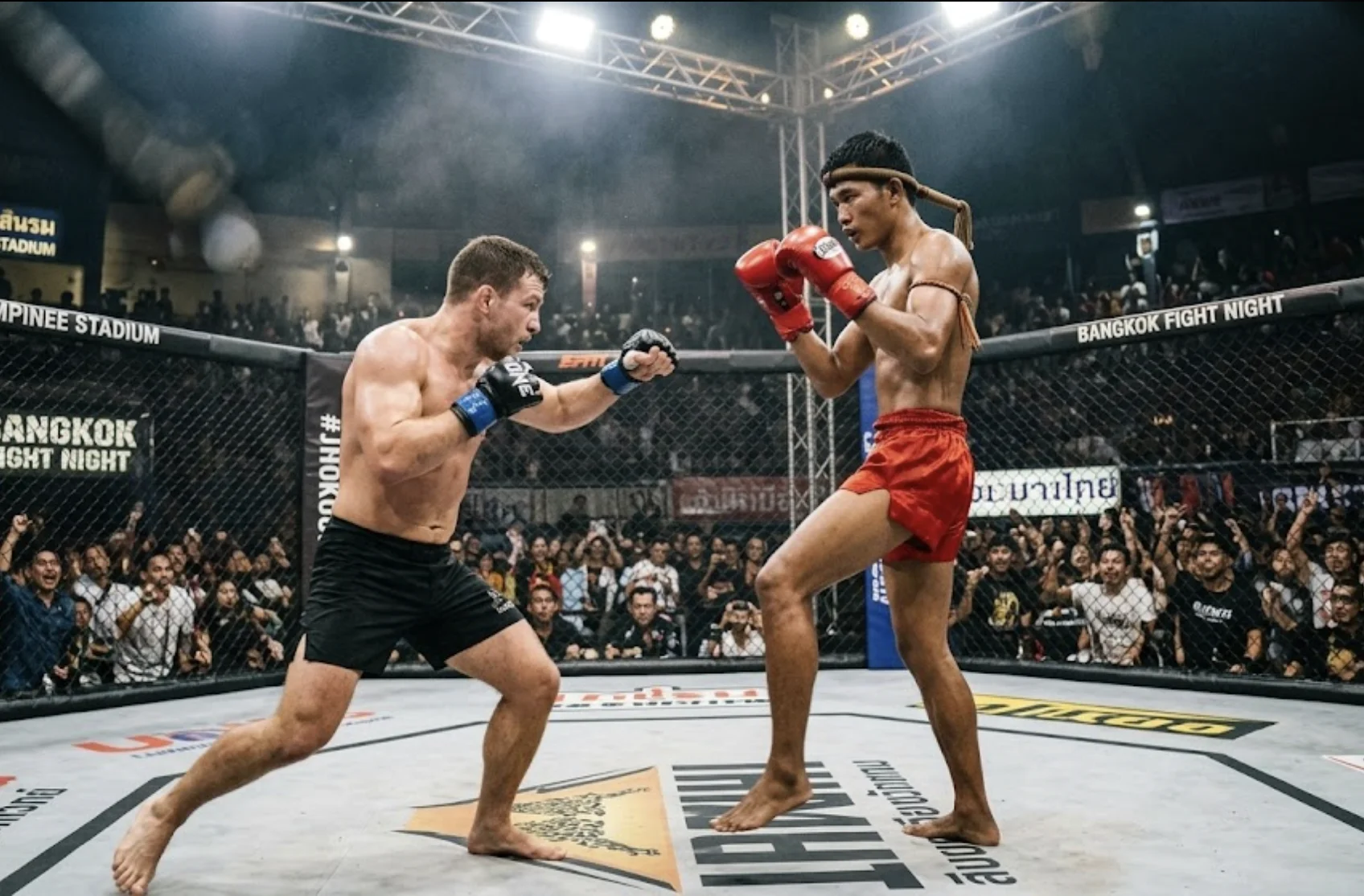
The question comes up from people new to both worlds, trying to understand the landscape before committing to a gym. Muay Thai or MMA? The question implies they are alternatives, options on opposite ends of a spectrum. The reality is closer to parent and child.
Modern mixed martial arts did not arrive fully formed. It developed through a period of genuine testing, where practitioners from different martial arts traditions competed against each other to discover what held up under live conditions and what did not. The striking that survived this process most effectively was Muay Thai. Its kicks, elbows, knees, clinch work, and footwork proved more complete and more adaptable than the alternatives, and the sport absorbed them as its striking foundation.
The relationship is not coincidental. It is the result of Muay Thai being the most thoroughly tested and refined striking system available, built over centuries of actual competitive combat.
What Muay Thai Is
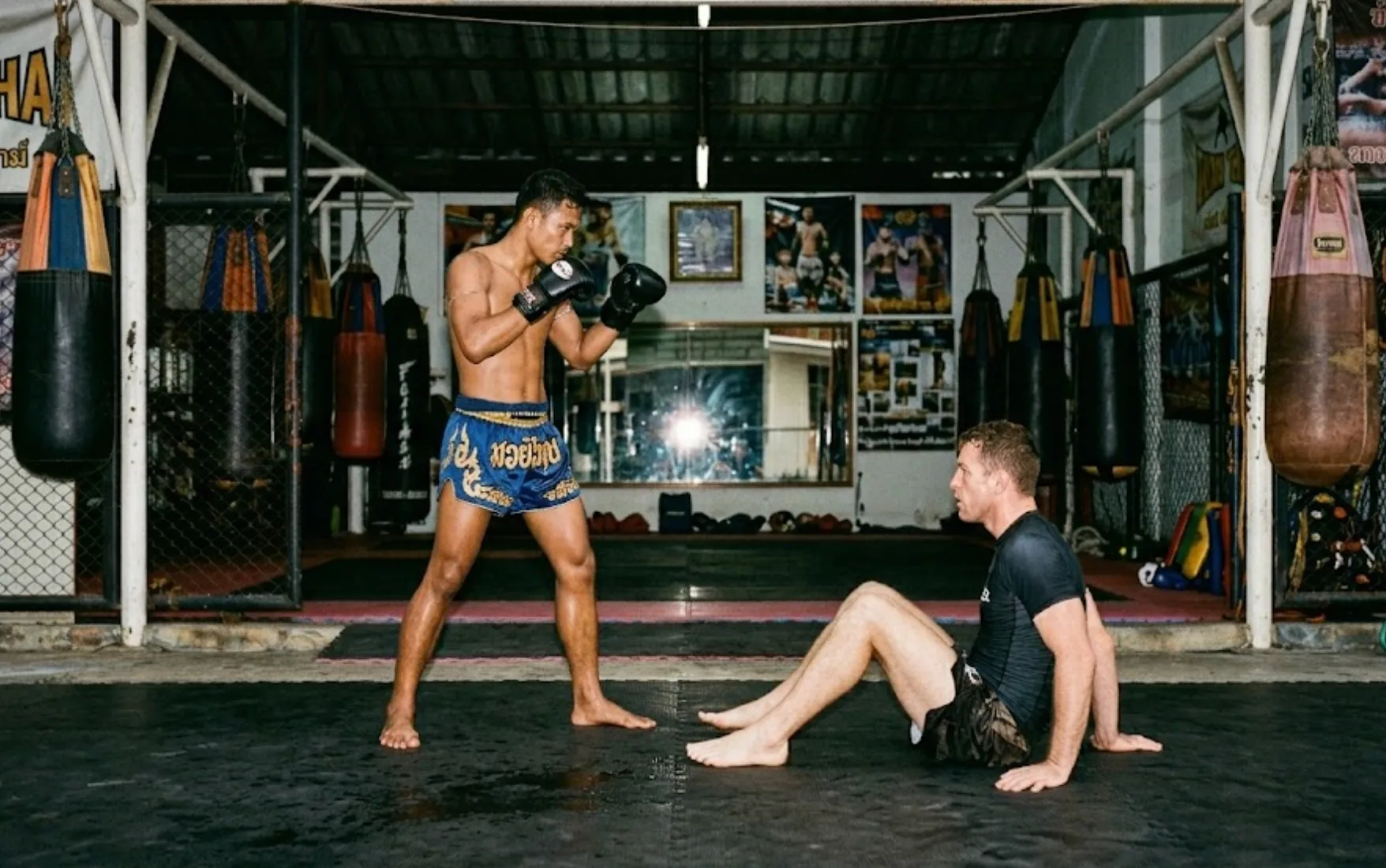
Muay Thai is a stand-up striking art. It operates from an upright stance, using fists, elbows, knees, and feet across a full range of distances, from long-range kicks to close-range clinch exchanges. The rules of competition in the traditional Thai system keep the fight standing. There is no ground work. There is no grappling beyond the clinch.
What it offers within those parameters is extraordinary depth. The eight weapons, the footwork, the clinch control, the tactical patience of high-level Thai fighting: these take years to develop properly and continue to reveal complexity at every stage. The sport has been refined by millions of practitioners over a very long period of time, and that refinement shows in the technique.
What MMA Is
MMA is a ruleset that allows striking and grappling in any combination, standing or on the ground. A practitioner needs to be effective at close range with punches and elbows, at mid range with kicks and knees, in the clinch, in the takedown or takedown defence, and on the ground in both offensive and defensive positions. The competitive demand is genuinely comprehensive.
No single martial art covers all of this. MMA training is therefore a synthesis, drawing from multiple disciplines to address each range and position. Muay Thai covers the striking range. Wrestling or judo typically covers the takedown game. Brazilian jiu-jitsu covers the ground. A serious MMA practitioner develops functional competence across all of them.
The breadth is MMA's defining feature. It is also what distinguishes it from Muay Thai most clearly. Muay Thai is a deep art within a specific domain. MMA is a wide art across multiple domains, drawing from each of them.
Where the Techniques Overlap
The Muay Thai techniques that appear most directly in MMA are the ones that translate most effectively under the ruleset.
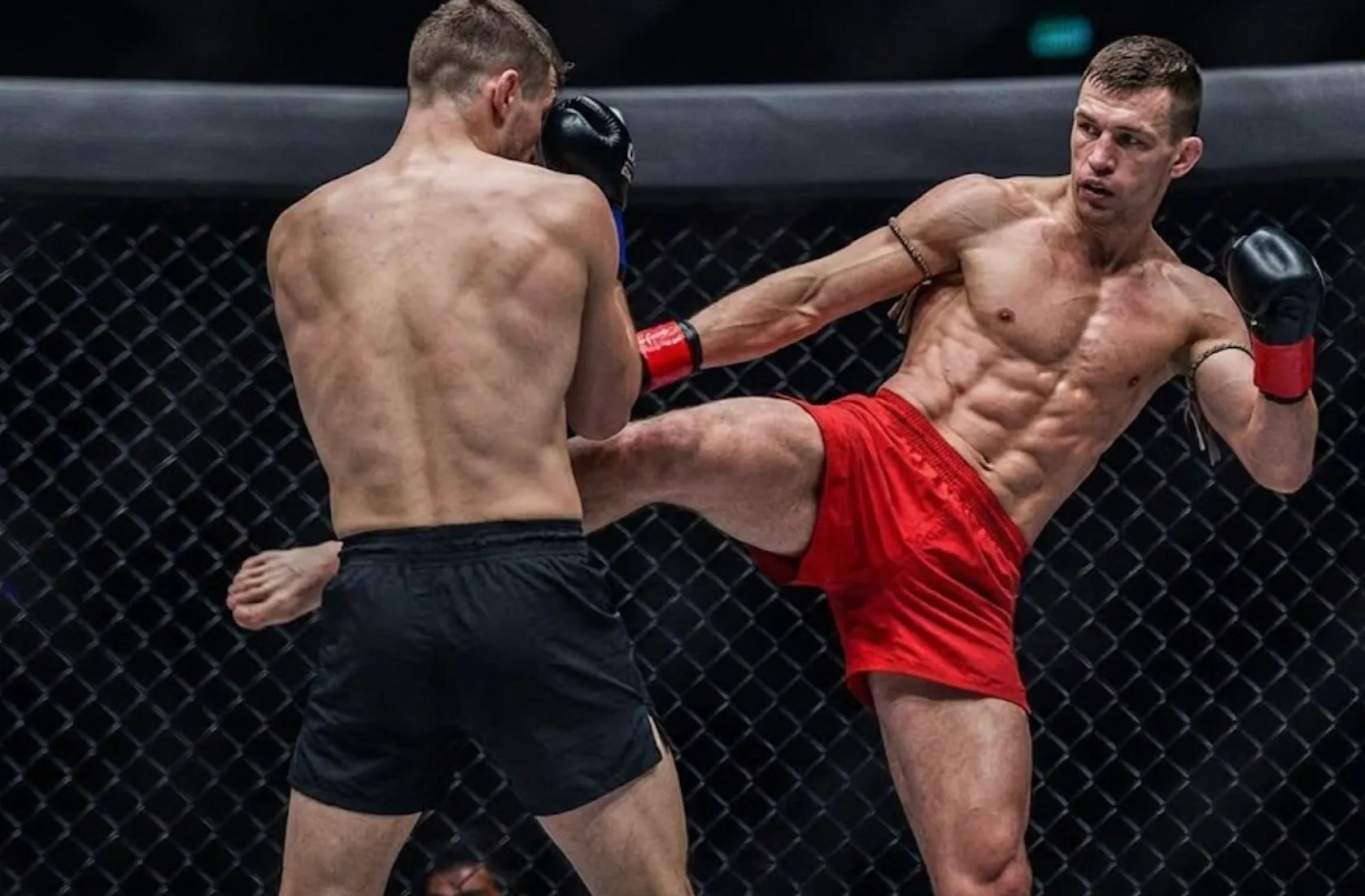
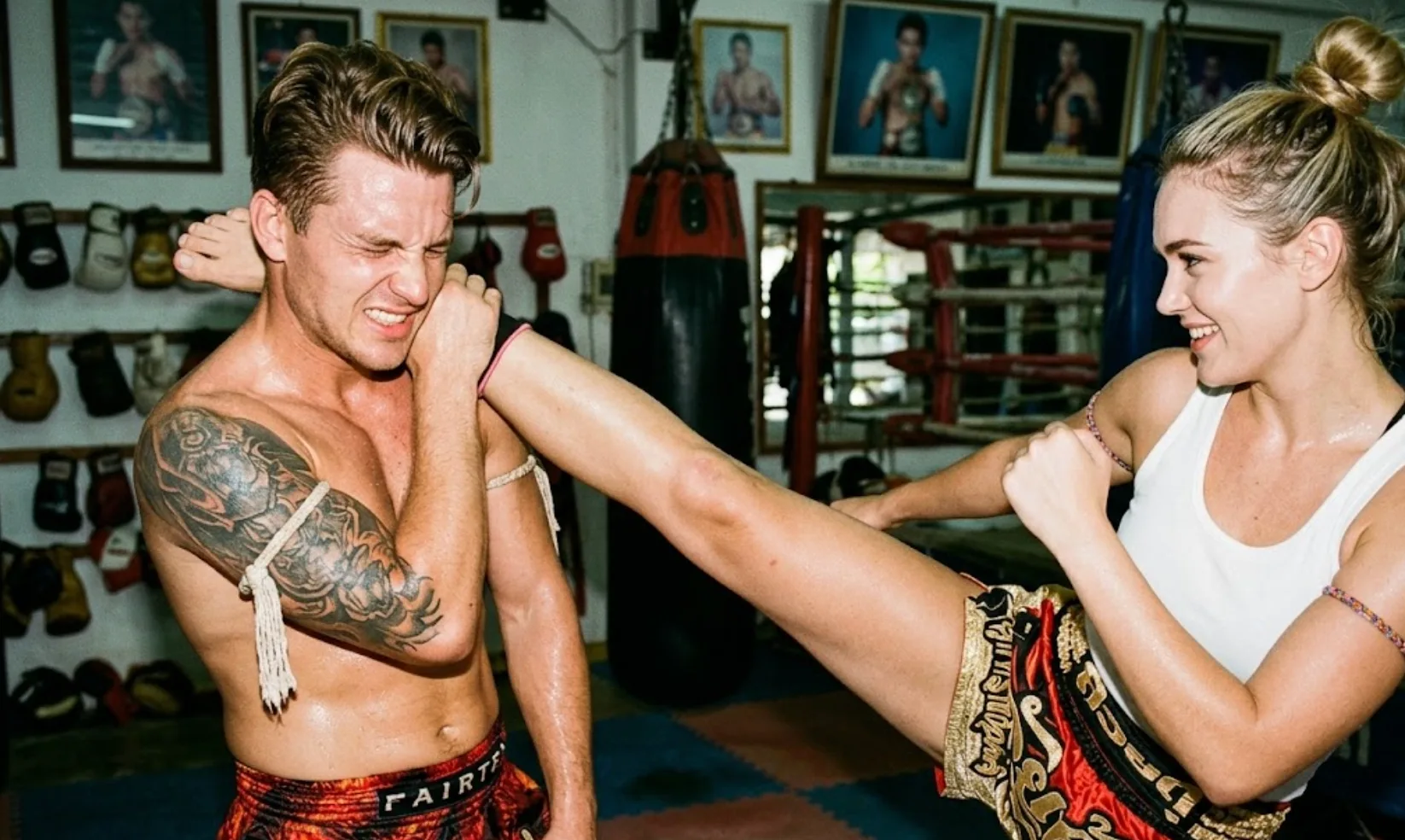
The teep, or push kick, is used constantly in MMA to control distance and interrupt takedown attempts. The roundhouse kick to the body and leg remains one of the most effective strikes available in any ruleset. Elbow strikes in the clinch, when permitted, are among the most dangerous close-range tools in MMA. Knee strikes from the clinch, including the flying knee, appear regularly at the highest levels.
The clinch itself is where the Muay Thai influence is most visible. MMA's clinch exchanges draw directly from Muay Thai neck tie control and body lock positions, though wrestling-based clinch work has added a takedown dimension that pure Muay Thai does not train.
Where They Diverge
The guard position in MMA differs from traditional Muay Thai because of the need to defend against takedowns. A lower, wider stance with the hands protecting the hips is common in MMA because it makes shooting for the legs more difficult. The traditional Muay Thai guard, upright and designed for striking exchange, becomes a vulnerability against a skilled wrestler.
The ground game is entirely absent from Muay Thai. A Muay Thai practitioner with no grappling training who ends up on the floor in MMA is at a serious disadvantage against anyone with wrestling or jiu-jitsu experience. This is the clearest gap between the two disciplines.
Some pure Muay Thai habits become liabilities in MMA. Dropping the hands after a kick, which is sometimes acceptable in Muay Thai where the opponent cannot shoot a takedown, becomes an invitation to a single-leg takedown in MMA. These adaptations are learnable, but they require specific attention.
Which One to Train
If competitive Muay Thai is the goal, train Muay Thai. The depth of the art rewards focused practice, and the competitive circuit is accessible at both amateur and professional levels internationally, especially in Thailand where the infrastructure around the sport is extraordinary.
If MMA competition is the goal, Muay Thai is the most useful first striking discipline to develop before adding grappling training. A strong Muay Thai base makes you a credible striker from day one in an MMA gym, and the clinch work, in particular, bridges directly into MMA's wrestling-influenced clinch exchanges.
If the goal is neither competition but the practice itself, the choice comes down to what excites you. Muay Thai's depth and tradition rewards practitioners who are drawn to technical mastery within a specific art. MMA's breadth rewards practitioners who find the problem-solving across multiple ranges more compelling than depth in a single one.
Both are serious, rewarding disciplines. They are more complementary than they are competing. The only bad outcome is choosing neither because you spent too long deciding. If you are still comparing striking arts, see Muay Thai vs Boxing and Muay Thai vs Kickboxing.
Frequently Asked Questions
Is Muay Thai part of MMA?
Yes. Muay Thai is widely considered the foundational striking system in modern MMA. The kicks, elbows, knees, clinch work, and footwork of Muay Thai have been adopted by MMA practitioners and coaches globally because of their effectiveness when tested against other styles under live conditions. Most elite MMA fighters either trained Muay Thai as their striking base or have incorporated its techniques extensively.
Should I train Muay Thai or MMA if I want to fight?
It depends on which ruleset you want to compete under. Muay Thai competition is its own circuit with its own weight classes, scoring, and culture, and is significantly more accessible at the amateur level in Thailand and internationally. MMA competition adds grappling and ground work to the equation. If striking is your strongest interest and competition in that domain is your goal, Muay Thai is the focused choice. If the complete range of fighting systems interests you, MMA is the broader path.
Can you do Muay Thai and MMA at the same time?
Yes, and many people do. Muay Thai training makes you a better MMA striker, and MMA training adds grappling dimensions that Muay Thai does not cover. The practical constraint is time and recovery. Most coaches recommend developing a strong base in one discipline before adding the other, rather than splitting attention across both from the start. Which you prioritise first comes down to your goals. See also Muay Thai vs Boxing and Muay Thai vs Kickboxing for more direct comparisons.
Is Muay Thai effective in MMA?
Extremely. Muay Thai's striking range covers distances that boxing and wrestling alone do not address. The clinch work, in particular, transitions naturally to MMA's clinch exchanges. Many of the most technically accomplished strikers in the UFC and other MMA promotions have either a Muay Thai base or have trained extensively in it. The sport has proven itself under the empirical test of MMA competition repeatedly.
Does MMA training ruin Muay Thai technique?
It can affect certain habits. MMA's need to defend against takedowns changes the stance and guard position compared to traditional Muay Thai, and the presence of ground work means that not every Muay Thai technique is optimal under MMA rules. Pure Muay Thai technique, practised in isolation, can also develop habits that become vulnerabilities in MMA, such as dropping the hands after kicks. These are adjustable. The fundamental techniques transfer well.